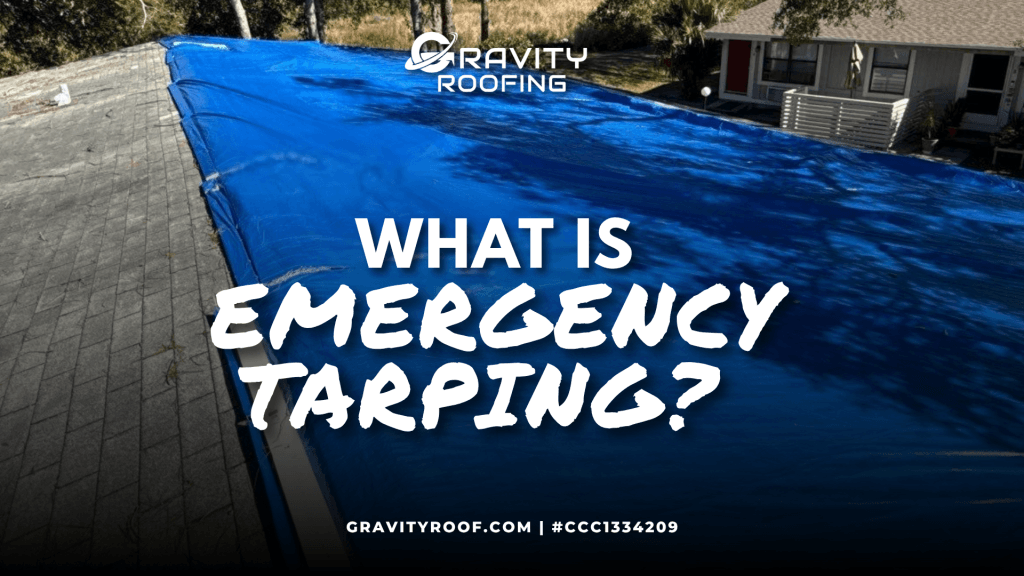
Emergency roof tarping. Emergency roof tarping is a temporary protective measure used when roof damage allows water to enter or leaves part of the roof exposed. It is not a permanent repair, and it should be evaluated and installed safely by a qualified professional.
TL;DR: Emergency roof tarping is a temporary protective covering placed over a storm-damaged roof area to help limit further exposure to rain while a permanent repair plan is developed. It is not a permanent roof repair, and it is not a safe DIY project. If you have an active interior leak, visible roof exposure, or significant storm damage, protect people and belongings safely, document what you can from the ground, and contact a qualified roofing professional. Gravity Roofing can discuss the next appropriate step and the availability of emergency roofing services as quickly as possible during business hours. Call (407) 461-0234.
Last reviewed: August 2026
After a severe storm or hurricane, homeowners may hear the word “tarping” almost immediately. It can sound like a simple fix: put a tarp over the roof and move on. In reality, emergency tarping is a short-term protective measure that should be evaluated and installed by a qualified professional when conditions are safe.
The purpose is not to hide damage or replace a repair. It is to help protect the home from further rain exposure while the roof is inspected and a permanent repair plan is made.
Emergency Roof Tarping: 5 Situations to Understand
Emergency roof tarping may help limit additional water exposure while a permanent repair plan is developed, but the right approach depends on the visible condition and safe access.
What emergency roof tarping actually is
Emergency roof tarping is the professional installation of temporary, weather-resistant covering over a damaged or exposed section of a roof. Depending on the roof condition, it may help reduce the chance of additional rain entering the home until permanent work can be completed.
The U.S. Army Corps of Engineers describes its disaster-specific Operation Blue Roof program as the use of fiber-reinforced sheeting to cover damaged roofs until permanent repairs can be arranged.[1] The same core principle applies to professional emergency tarping: it is temporary protection, not a roof replacement and not a permanent repair.
A proper decision about tarping starts with safety and an assessment. A professional needs to determine whether the roof can be accessed safely, whether a temporary cover is appropriate for the observed condition, and what needs to happen next.
When emergency tarping may make sense
Not every storm event or roof concern requires a tarp. A professional may recommend temporary protection when there is a reasonable concern that the roof is exposed to additional water intrusion before a permanent repair can be made.
| Possible condition | Why a professional assessment may be needed |
|---|---|
| Active interior water intrusion after a storm | A temporary cover may help reduce additional exposure while the source is evaluated. |
| Visible opening or exposed roof area | A professional can determine whether the area needs temporary protection. |
| Missing or severely displaced roofing materials | Wind or debris may have exposed layers beneath the visible roof surface. |
| Damage around a roof transition | Vents, skylights, chimneys, and wall intersections can be vulnerable to wind-driven rain. |
| Major debris impact | A branch or other impact can create a condition that is not fully visible from the ground. |
These are reasons to call for a professional assessment, not automatic proof that a tarp is needed. A ceiling stain, a missing shingle, or a storm report by itself does not reveal the full roof condition.
What emergency tarping does—and does not—do
A temporary roof cover can be useful, but homeowners should understand its limits.
| Emergency tarping can | Emergency tarping cannot |
|---|---|
| Provide short-term protection over an assessed, damaged roof area | Permanently repair the roof or restore its full original condition |
| Help reduce additional rain exposure while permanent work is planned | Guarantee that no more water will enter the home |
| Give the homeowner time to develop a documented repair plan | Diagnose every source of interior moisture |
| Create a visible record that professional temporary protection was performed | Determine insurance coverage or guarantee reimbursement |
A tarp should remain a temporary measure. Its condition can change with wind, rain, sun exposure, roof shape, and the underlying damage. A professional should explain the next step toward a permanent repair rather than treating the tarp as the end of the job.
What to do while you wait for a roofing professional
- Keep people safe. Stay off the roof and away from damaged exterior areas, downed power lines, unstable trees, or wet electrical components.
- Protect the interior only if it is safe. Move valuables away from an active drip. Place a container under water if appropriate. Do not puncture a sagging ceiling or touch wet light fixtures.
- Document visible conditions. Take photos and short videos from safe locations. Include interior stains or drips, the roofline from the ground, damaged gutters, and debris.
- Keep records. The Florida Department of Financial Services encourages homeowners to keep photos, videos, notes, and receipts for professional work after a disaster.[2]
- Contact a qualified roofing professional. Describe what you are seeing and follow its safety guidance. If you have insurance questions or are considering a claim, speak directly with your insurer or agent.
Do not climb a ladder, walk on a wet or damaged roof, or try to secure a tarp yourself. CertainTeed advises homeowners to limit their own inspection to a visual observation from the ground and leave roof-level work to trained professionals because roof access can be dangerous.[3]
Why professional installation matters
A damaged roof is not a stable work surface. It may be wet, slippery, weakened, or affected in places that cannot be seen from below. Professional roofers have the training, equipment, and roof-level perspective needed to assess whether temporary protection is appropriate.
| Professional service | Why it matters |
|---|---|
| Assess the roof condition safely | Helps determine whether a tarp or another temporary measure is appropriate. |
| Photograph observed roof-level conditions | Creates a documented record of what was found. |
| Install temporary protection when appropriate | Helps limit exposure while a permanent repair plan is developed. |
| Explain the distinction between protection and repair | Keeps expectations clear and supports better decisions. |
| Provide a repair recommendation | Gives the homeowner a documented next step once conditions allow. |
Gravity Roofing can inspect the roof, document observed conditions, discuss whether temporary protection is appropriate, and explain permanent repair options. The company does not promise a particular response time, insurance result, or repair outcome.
What about insurance and temporary roof protection?
The Florida Department of Financial Services advises homeowners to assess visible damage, take photos or notes, identify necessary emergency work to help prevent further damage, retain receipts for professional work, and notify the insurer of the loss.[2]
Whether a policy covers temporary protection, repair work, or any other expense depends on the specific policy, the cause of loss, deductibles, prior conditions, exclusions, and the insurer’s investigation. Do not rely on a contractor or social-media post to determine coverage. For policy or claim questions, contact your insurer or agent directly.
Gravity Roofing can provide roof observations, photographs, repair recommendations, and invoices for the work it performs. It does not interpret insurance policies, act as a public adjuster, negotiate claims, or guarantee payment. For a broader recovery guide, read Navigating Roof Repairs and Insurance Claims After a Hurricane once Blog 07 is published.
Is Operation Blue Roof available in Florida?
Operation Blue Roof is a federal temporary-roofing program managed by the U.S. Army Corps of Engineers for FEMA. It may operate only after FEMA assigns a mission at the request of an affected state. Its availability, sign-up details, and eligible areas are specific to the declared disaster.[1]
Because it is not a year-round benefit, homeowners should rely on official USACE, FEMA, and local emergency-management announcements after a declared event. The official USACE page reported no active mission when this article was last reviewed. Do not assume the program is active after every hurricane or severe storm.
How long can a roof tarp stay in place?
There is no safe universal number of days. A tarp’s useful life depends on the material, installation, roof slope, wind exposure, weather, sun, underlying damage, and whether the tarp stays intact.
The important point is that emergency tarping is temporary. It should be followed by a professional repair plan and monitored for changes. If a tarp shifts, tears, or no longer appears to protect the exposed area, contact a roofing professional rather than attempting to fix it yourself.
Protect your home. Protect your peace. A tarp is a temporary bridge to a proper repair—not a permanent answer. If you have active leaks or visible storm damage, contact Gravity Roofing to discuss emergency roofing services or call (407) 461-0234. We will respond as quickly as possible during business hours.
If you think emergency roof tarping may be needed, Gravity Roofing can discuss the next appropriate step and respond as quickly as possible during business hours.
Frequently Asked Questions
What is emergency roof tarping?
Emergency roof tarping is the professional installation of a temporary, weather-resistant covering over an assessed storm-damaged roof area. Its purpose is to help limit further rain exposure while a permanent repair plan is developed.
When does a roof need emergency tarping?
A professional may recommend temporary protection when there is active water intrusion, visible exposure, severely displaced roofing material, storm damage around roof transitions, or a major debris impact. The need depends on the observable roof condition and a safe professional assessment.
Is emergency tarping a permanent repair?
No. A tarp is temporary protection. It does not permanently restore the roof, guarantee that water will not enter, or replace a professional repair plan.
Can I tarp my roof myself after a storm?
Homeowners should not climb onto a wet or potentially damaged roof to install a tarp. Roof access after a storm can be dangerous. Limit your own observations to safe indoor and ground-level checks, and let a qualified professional evaluate roof-level conditions.
Does insurance cover emergency roof tarping in Florida?
Coverage depends on the specific policy, cause of loss, deductible, prior conditions, exclusions, and insurer investigation. Florida consumer guidance encourages documentation and receipt-keeping for professional emergency work. For coverage questions, contact your insurer or agent directly.
How long can a roof tarp stay on?
There is no universal timeframe. A tarp is temporary and its condition can be affected by weather, wind, sun, installation, roof shape, and underlying damage. A professional should develop a permanent repair plan and advise on monitoring the temporary protection.
Is Operation Blue Roof available in Florida?
Operation Blue Roof may operate only after FEMA assigns a mission at the request of an affected state. It is not a year-round benefit, and availability is specific to the declared disaster. Check official USACE, FEMA, and local emergency-management announcements after a major event.
What should I do while waiting for a roofing professional?
Keep people safe, move valuables away from an active drip if it is safe, use a container under water if appropriate, take photos from safe locations, and keep notes and receipts. Do not climb onto the roof, use a ladder, or attempt a DIY tarp.